News
Red flags in clinical practice: expert insight on cauda equina syndrome

The third article in our "Red Flags in Clinical Practice" series focuses on Cauda Equina Syndrome.
By Rachel Makore, Associate Clinical Negligence Solicitor
In my work as a clinical negligence solicitor, I regularly act for clients where a serious condition was not identified at the earliest opportunity.
A common feature in many of these cases is not a lack of clinical knowledge, but a failure to recognise, properly weigh, or act on key features in a patient’s presentation.
This forms part of our “Red flags in clinical practice” series, where frontline clinicians share insights into recognising time-critical conditions and understanding how delays in diagnosis can occur.
By exploring these issues from a clinical perspective, alongside the medico-legal context in which they often arise, the aim is to provide a clearer understanding of how delays in diagnosis occur and the very real consequences they can have for patients.
In this third article (you can read the previous articles here, Sibghat Ullah, Chartered Physiotherapist, shares his perspective from primary practice, focusing on assessing and managing patients with spinal conditions, including Cauda Equina Syndrome.
Introduction
I qualified as a physiotherapist in 2014 and currently work in the NHS as an Advanced Physiotherapist Practitioner in musculoskeletal practice. I hold over a decade of clinical experience in assessing and managing patients with spinal conditions, including Cauda Equina Syndrome.
Alongside my clinical role, I work as a physiotherapist expert witness for Somek and Associates and accept instructions from both Claimant and Defendant solicitors in cases of alleged clinical negligence. The complementary blend of clinical and medico-legal work has provided me with significant insight into the real-life consequences that can arise when a patient’s care falls below the standard expected of a reasonably competent physiotherapist.
What is Cauda Equina Syndrome (CES)?
CES is a rare but debilitating condition, in which the nerves below the spinal cord in the lower back are compressed, resulting in neurological dysfunction. Delayed diagnosis and management of CES can have a devastating impact and give rise to permanent, irreversible symptoms including loss of bladder and bowel function, loss of sexual function, lower limb paralysis and chronic pain.
Due to the risk of rapid deterioration and permanent nerve damage, CES is generally treated as a medical emergency and timely management is crucial. An MRI scan of the lower back is the gold standard diagnostic investigation and, if CES is confirmed, urgent surgical decompression is typically required. Despite increasing awareness of CES, delayed diagnosis and management continue to occur, resulting in significant long-term disability for affected patients.
Red flags for CES
NHS Getting It Right First Time (GIRFT) provides a national framework and interactive toolkit for all clinicians in the assessment of patients with suspected CES. The guidance by NHS GIRFT identifies five key symptoms, also known as ‘red flags’ for CES, that the patient should be questioned on:
- Difficulty initiating urination or impaired sensation of urinary flow.
- Altered sensation or numbness in the genital or ‘saddle’ area.
- Severe or progressive neurological symptoms, such as weakness in both legs.
- Loss of sensation of rectal fullness.
- Sexual dysfunction including the inability to achieve erection or ability to ejaculate, and/ or loss of genital sensation.
CES remains diagnostically challenging, as it does not have a set pattern of symptoms and normal physical tests do not exclude CES when symptoms are present. Physiotherapists assess many patients with benign low back pain, and given the comparative rarity of CES, relevant symptoms can often be overlooked and misattributed to other causes.
In my experience, there are three recurring clinical issues that arise in the delayed diagnosis of CES:
1. Failure to elicit relevant symptoms
A common pitfall in CES assessment is a lack of recognition of subtle, often early symptoms. Some physiotherapists may only ask about more significant, overt CES symptoms such as bladder incontinence. This approach risks overlooking key features such as altered urinary sensation or hesitancy. In failing to undertake specific and detailed questioning, relevant symptoms can be missed, contributing to delayed diagnosis.
2. Over-reliance on physical tests
Another common oversight in CES assessment is deriving false reassurance from normal physical test findings. Examples include an unremarkable assessment of lower limb neurology and normal digital rectal examination, which assesses anal sensation and muscle function. Over-reliance on physical examination findings, rather than the patient’s history, presents considerable risks, as early CES symptoms may develop before more obvious signs of neurological dysfunction such as lower limb weakness. It is increasingly understood that the most informative features that should raise suspicion of CES are patient-reported symptoms.
3. Inadequate safety netting
Safety netting for CES is the process of informing patients of signs and symptoms suggestive of CES, and advising upon appropriate action in the presence of such features. The provided information must be readily understood by patients, and NHS GIRFT recommends the use of a video and information card (see figure 1) to support this process. CES symptoms may evolve over time and not be present upon initial consultation. Safety netting can empower patients to seek urgent medical attention in the instance of new or progressive CES features. Inadequate safety netting, whereby a clinician has failed to provide sufficient information to a patient, can result in delayed diagnosis and management.
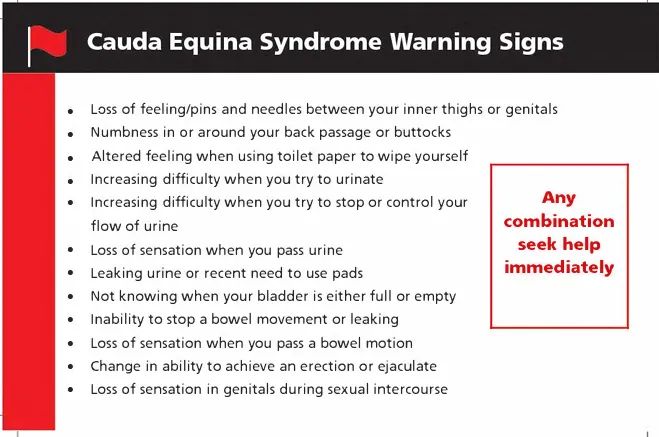
Figure 1
Case example: Delayed diagnosis of CES
A 35-year-old male attends physiotherapy due to the onset of low back pain and sciatic right leg pain. During assessment, he is asked if he has had any bladder or bowel incontinence or genital numbness, to which he responds ‘no’. His neurological examination reveals no significant leg weakness or numbness and he is offered reassurance, and a follow-up appointment. No safety netting advice is provided. Following the appointment, his symptoms deteriorate and he develops bladder incontinence. He attends A&E, and an MRI scan reveals cauda equina compression. He subsequently undergoes surgical decompression but unfortunately never regains normal bladder function.
Based on this case example, the physiotherapist failed to ask about the more subtle symptoms of CES, derived false reassurance from physical tests, and provided no safety netting advice. These factors subsequently contributed to the patient’s delayed diagnosis.
If I could change one thing…
I would encourage clinicians to carefully listen and place the greatest emphasis on patient-reported symptoms. CES rarely presents in a textbook fashion, and often early symptoms can be subtle. By asking the right questions, and exploring the patient narrative, clinicians are more likely to identify CES earlier. As Sir William Osler, often regarded as the father of modern medicine, famously stated: ‘Listen to your patient, he is telling you the diagnosis’.
Contact Dean Wilson LLP
If you or a loved one has experienced a delay in the diagnosis of Cauda Equina Syndrome, and you have concerns about the care received, our clinical negligence team would be happy to offer initial guidance. Please contact us on 01273 249200 or visit our Medical Negligence page for further information.
More News
On Medical Negligence

Sevenfold Increase In Settlement Offer In GP Negligence Claim

Clinical Negligence Claim Settled for £465,000 Following Development of Complex Regional Pain Syndrome